

NEURODEGENERATION- ALS PROGRAM
In over 95% of ALS patients, cytoplasmic accumulation of TAR DNA Binding Protein 43 kDa (TDP-43) and the subsequent lack of TDP-43 in the nucleus, is a pathological hallmark of the disease. Given the effect of TDP-43 on mRNA splicing and stability, the lack of TDP-43 in the nucleus has a number of consequences, one of them being the dysregulation of the stress response. A key player which drives the stress response and protects motor neuron viability, is G3BP1. The transcript which encodes G3BP1, is regulated by mRNA stability through the binding of TDP-43. With the loss of TDP-43 in the nucleus in ALS patients, G3BP1 mRNA is destabilized leading to a dysregulation of the stress response, and with it, death of motor neuron cells which cannot be regenerated.
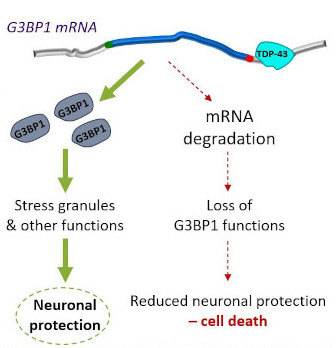
Using Novation's QUEST technology, a cell-based assay was developed and used to screen Novation's in-house library. With the goal of rescuing G3BP1 mRNA stability, and thus protein levels, under TDP-43 depleted conditions which mimics the ALS pathology, it is Novation's goal to reset the stress response, preventing motor neuron cell death.

Copyright © 2003 - 2026 Novation Pharmaceuticals, Inc. All rights reserved.